

Quarterly Review on Q4 2025 Trends in M&A, Activism and Corporate Governance
Mergers & Acquisitions
WHY BUYERS ARE INCREASINGLY TURNING TO STATE LAW TO ACQUIRE DISTRESSED ASSETS
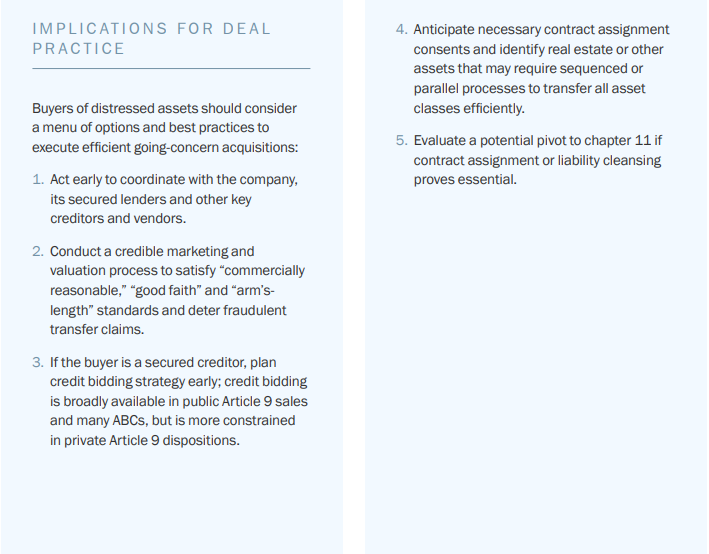
For companies and stakeholders seeking to execute distressed asset sales with speed, certainty, cost control and surgical execution, state law regimes offer non-bankruptcy alternatives to chapter 11 bankruptcy sales.[1] These state law regimes can facilitate distressed M&A transactions with significantly lower administrative costs, tighter timelines and greater process control, especially where secured creditors or other key stakeholders cooperate to drive a coordinated strategy.
One such state law mechanism, Uniform Commercial Code (UCC) Article 9 sale, implements a secured creditor’s statutory right to enforce against defaulted personal property-type collateral and dispose of it via public or private sale subject to the overarching requirement that every aspect of the disposition be “commercially reasonable.” Public sales permit credit bidding, generally require notice to only the debtor and other lienholders and allow the buyer to take assets free and clear of the foreclosing and subordinate liens. Private sales can be faster but require strong evidentiary backing (marketing, valuation) and limit credit bidding absent a recognized market for the assets.[2]

Another state law mechanism, an assignment for the benefit of creditors (ABC), assigns assets to an independent fiduciary who is responsible for selling the assets for the benefit of creditors under state law priority rules, with practice varying meaningfully by jurisdiction (e.g., Delaware, California, New York, Florida have some of the more developed ABC statutes or common law).[3] Some ABCs feature court-approved auction procedures, enable credit bidding and can deliver assets free of junior liens within state-law limits.
Companies and senior lenders choose Article 9 sales and ABCs to maximize value through a going-concern sale while minimizing cost, delay and publicity relative to chapter 11 bankruptcy. Both regimes can be faster and cheaper than a chapter 11 bankruptcy sale, and they offer adaptable playbooks when cooperatively pre-planned among lenders and borrowers (e.g., joint selection of an assignee). They may be especially attractive where liquidity is too tight to fund a chapter 11 process but sufficient to support a targeted, pre-marketed sale.
Article 9 sales are typically the lowest-cost, fastest path, with narrow notice requirements and strong secured-lender control; however, they are weaker on contract assignment and “free-and-clear” breadth than a chapter 11 bankruptcy sale, leaving greater successor liability and fraudulent transfer risk. ABCs provide a middle ground: more process protection and broader asset reach (including non-collateral assets) than Article 9, although less uniform and less cleansing than bankruptcy. These tools work well where creditors have liens on substantially all operating assets or are otherwise positioned to coordinate a commercially reasonable marketing and sale process and business continuity strategy (e.g., TSAs, key employee retention). For example, in 2025, Animal Supply Company completed a going-concern sale to Pet Food Experts via an Article 9 sale, followed by an ABC.[4] Institutional secured lenders supported the out-of-court sale, the buyer negotiated with a handful of key vendors, landlords and trade creditors on a case-by-case basis to maintain key contracts and the ABC assignee provided transition services. The sale incurred a few million dollars in aggregate professional fees and other administrative expenses, significantly less than would be expected for a chapter 11 bankruptcy sale.
Parties can plan ahead to address the limits of these non-bankruptcy regimes. Article 9’s inapplicability to real estate and certain licenses may necessitate parallel pathways to execute a going-concern sale of substantially all operating assets (e.g., mortgage foreclosure, follow-on ABC). Additionally, contractual anti-assignment clauses remain enforceable in both Article 9 and ABCs, so counter-parties’ consent or alternative arrangements may be required.
Sometimes, chapter 11 may be the optimal or only viable path forward where contract assignability or liability cleansing proves essential to maximizing the value of the business. For example, in 2024, True Value relied on an expedited (6 weeks) chapter 11 process to sell its business to stalking horse bidder Do It Best because the secured lenders did not support an out-of-court process and significant contract and lease assignability was required to transition the business.[5] The sale incurred an estimated $25 million in professional fees and costs.[6]
KEY DEVELOPMENTS IN DELAWARE CASE LAW
Compensation Plans and Remedies
In re Tesla, Inc. Derivative Litigation, C.A. No. 2018-0408 (Del. Supr. Ct. Dec. 19, 2025)
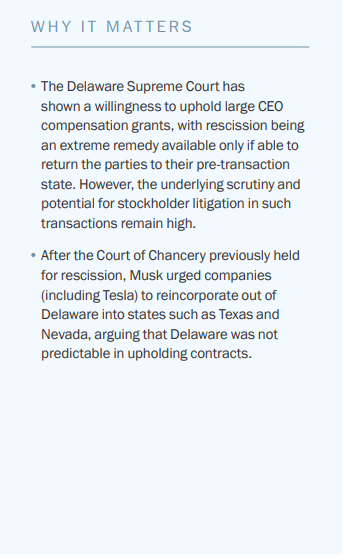
In 2018, the Tesla, Inc. (“Tesla”) board of directors and Tesla stockholders approved an equity compensation grant for Tesla CEO and controlling stockholder Elon Musk. The grant included twelve tranches of stock options that vested after Tesla reached market capitalization and operational milestones. Under the grant, full achievement of such milestones would award Musk stock options in Tesla with an approximate maximum theoretical value of $55.8 billion, the largest executive compensation package in history at the time. Musk fully performed under the 2018 grant and all the 2018 grant’s twelve milestones were achieved.
In a derivative lawsuit, a Tesla stockholder claimed that Musk and the Tesla directors who approved the 2018 compensation grant breached their fiduciary duties. The plaintiff also argued that Tesla’s stockholder vote approving the 2018 grant had not been fully informed. The Delaware Court of Chancery (the “Court of Chancery”), applying the entire fairness standard, held for the plaintiff and ordered rescission of the grant. Tesla sought a second stockholder vote to ratify the 2018 grant, and included additional disclosures in the related proxy statement. The stockholders again approved the 2018 grant. Based on this second vote, Tesla requested that the Court of Chancery revise its post-trial opinion. The Court of Chancery denied that request and, on appeal, the defendants argued, among other things, that the Court of Chancery erred in its entire fairness analysis, in granting rescission, in not giving effect to the second stockholder vote and in awarding excessive fees to plaintiff’s counsel.
The Delaware Supreme Court reversed the rescission of the 2018 compensation grant on the basis that rescission was an improper remedy. The court therefore reinstated the 2018 grant and awarded the plaintiff nominal damages of $1. The court held that rescission requires the ability to restore the parties to the status quo ante (i.e., their pre-transaction positions) and, therefore, rescission would be inequitable because Musk had already spent years achieving all of the grant’s milestones and it would not be possible to restore Musk to the same bargaining position as before those successful efforts occurred. Unlike the Court of Chancery, the Supreme Court held that it was not a valid argument for rescission that Musk had been sufficiently compensated by his large ownership stake in Tesla, which he held before the 2018 compensation grant. The court also awarded the plaintiff’s counsel a $54 million fee award based on quantum meruit and a four times multiplier, with post-judgment interest, substantially less than the Court of Chancery’s award of $345 million dollars.
Fiduciary Duties and Aiding-and-Abetting Liability
Sjunde AP-Fonden v. Activision Blizzard, Inc., et al., No. 2022-1001-KSJM, 2025 WL 2803254 (Del. Ch. Oct. 2, 2025) (Activision-Microsoft Merger Challenge)
At entertainment company Activision Blizzard, Inc. (“Activision”) in late 2021, Activision’s CEO, Bobby Kotick, faced criticism, employee protests and public and regulatory scrutiny for alleged pervasive sexual misconduct issues at the company. Amidst news about the scandal, a group of Activision board members with longstanding ties to Kotick engaged in negotiations regarding a sale to Microsoft, Inc. (“Microsoft”). The group of directors negotiating with Microsoft set a negotiating range of $90 to $105 per share, even though Activision’s board had recently approved a long-range strategic plan which implied a price range of $113 to $128 per Activision share. Within twelve days of first learning of Microsoft’s interest in buying Activision, Activision’s board agreed to sell the company to Microsoft for $95 per share (a roughly $69 billion deal). The merger agreement included protections for Kotick once the deal had closed that he did not then enjoy at Activision, such as broadened liability protections and a key-man provision maintaining his position as CEO. The merger was approved by stockholder vote in 2022 and closed in October 2023 after regulatory delays. During these delays, Activision released multiple blockbuster video games and reported exceptional financial performance, surpassing historical projections, consensus price estimates and the wider industry.
The plaintiff, Sweden’s Sjunde AP-Fonden pension fund (“AP-Fonden”), an Activision stockholder, alleged that the Activision board and Kotick rushed the sales process to protect Kotick and other directors from the fallout of the scandal rather than maximizing value for stockholders. AP-Fonden claimed the majority of the board was conflicted and that the board failed to maximize stockholder value through the sale process and that the stockholder vote was insufficiently informed to give rise to Corwin cleansing. The plaintiff also claimed that Microsoft aided and abetted these fiduciary breaches. The defendants moved to dismiss.
The court denied the motion to dismiss the plaintiff’s core claims against the company and its directors. The court applied the Revlon framework of enhanced scrutiny at the pleading stage, rather than giving effect to Corwin cleansing, because it was reasonably conceivable that (i) the stockholder vote did not comply with all statutory formalities under the DGCL and (ii) the proxy statement was materially misleading and incomplete. Applying Revlon standards, the court found it reasonably conceivable that the board breached their fiduciary duties in rushing into the Microsoft deal to protect Kotick’s interests. However, the court dismissed all aiding-and-abetting claims against Microsoft, finding that while Microsoft executives negotiated hard for a quick, favorable deal, they did not knowingly aid Activision’s board in allegedly violating the law.

Limits of Fiduciary Duties
Brola v. Lundgren, No. 2024-1108-LWW, 2025 WL 3439671 (Del. Ch. Dec. 1, 2025)
Brola, the plaintiff, was a 50% stockholder and president of a small, closely held finance technology company, and Lundgren, the defendant, was the other 50% stockholder and a former vice president and director of the company. Brola sued Lundgren derivatively on behalf of the company for engaging in a pattern of sexual harassment against subordinate employees. This behavior, which led to Lundgren’s termination, also led to costly litigation for the company and settlements totaling $1.8 million. Brola alleged that Lundgren’s conduct breached Lundgren’s fiduciary duty of loyalty to the company.
The court dismissed this fiduciary duty claim, holding that Lundgren’s actions were personal misconduct, not a misuse of his corporate office. This holding limited the decision in In re McDonald’s Corp. Stockholder Derivative Litigation, in which another court held that an executive’s pattern of sexual harassment did breach the duty of loyalty. However, the court noted that, unlike in this case, the officer in McDonald’s had an affirmative oversight duty to monitor and prevent workplace misconduct in his role as the top human resources department manager.
In Lundgren, the defendant was not specifically charged with any board-level responsibility for preventing harassment and the misconduct was not tied to any corporate decision or benefit. The court disagreed with the plaintiff’s arguments from McDonald’s that sexual misconduct is selfish, selfishness is disloyal and therefore, sexual misconduct is a breach of the fiduciary duty of loyalty, finding that Delaware law does not support such an expansive interpretation of the duty of loyalty. The court argued such an interpretation would make a fiduciary disloyalty issue out of “every self-serving reprehensible act by an officer” such as “a breakroom fistfight, a defamatory social media post, or theft of office supplies.” Finally, the court argued that, for public policy reasons, such harassment claims would be better served through employment law and tort law than corporate law.

Activism
RISING TREND OF ACTIVIST CREDITORS SEEKING TO ASSERT LEVERAGE THROUGH “COOPERATION AGREEMENTS”
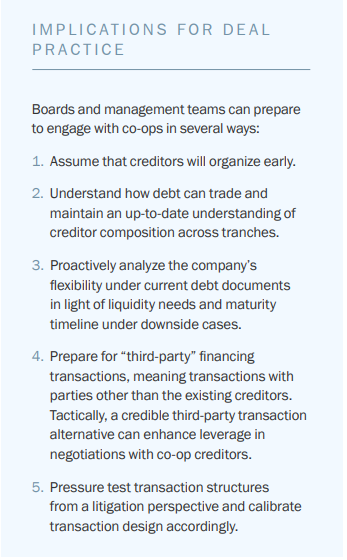
Creditor cooperation agreements, or “co-ops” for short, have emerged as a defining feature of the leveraged credit landscape, reshaping the dynamics between companies and activist creditors in stressed and opportunistic situations. Boards and management teams should be prepared to recognize the conditions under which co-ops are likely to form, understand the activist creditors’ playbook and proactively take steps to address potential activist creditors.
In recent years, below-investment-grade borrowers and their creditors have turned to so-called “liability management exercises” (LMEs). LMEs rely on covenant-lite debt documents to execute refinancing transactions whereby narrow majorities of activist lenders provide new money, extend maturities or exchange debt in a manner that is detrimental to the remaining lenders. While transaction structures vary, creditors that are excluded from an LME often end up with debt instruments that are contractually or structurally “junior” to the majority group, resulting in a significantly higher-risk investment than they originally bargained for. This dynamic is sometimes labeled “creditor-on-creditor violence,” and in many cases has led to protracted litigation with unpredictable outcomes.
In response, co-ops have become both a defensive and offensive tool for creditors. A co-op is, at its core, a contract among a company’s creditors that coordinates strategy, information-sharing and negotiation parameters. Co-ops often include trading restrictions (potentially including restrictions on co-op members’ ability to individually transact with the borrower) and supermajority decision mechanics designed to centralize bargaining authority and control outcomes. Many such agreements are drafted to meet the 50.1% “required lender” threshold, enabling the group to control amendments to existing debt documents and to block or direct transaction pathways.
Not all co-ops are built alike. Structures range from bare majority lockups that provide the company latitude to manage optionality, to broad, multi-tranche constructs with near-universal participation that can significantly constrain a company’s ability to capture discounts or pursue non-pro-rata transactions. For example, call center company Foundever’s creditors executed a co-op agreement with some 88% of loans (over their 50.1% target threshold) with non-pro-rata provisions, including enhanced economics for steering committee creditors in future transactions.[7]
On the other end of the spectrum, sometimes broad and restrictive agreements come together with striking scale and speed. For telecommunications company Altice France, more than 90% of term lenders and over 75% of secured bondholders executed a co-op within two weeks, effectively forestalling a perceived coercive exchange and cementing negotiating leverage against the company.[8] When chemical company DuPont made an exchange offer to three tranches of bondholders in connection with the spin-off of its electronics business unit earlier this year, bondholders responded by organizing into a first-of-their-kind co-op among investment-grade creditors for the purpose of securing better economics in the exchange offer, ultimately defeating the proposed transaction.[9],[10] This could mark the beginning of the spread of co-ops to investment-grade debt.
Threat of litigation has become a common backdrop for LME and co-op negotiations. Excluded creditors routinely challenge coercive LMEs, such as the uptiering transactions involving Serta and Incora.[11],[12] For the first time, in 2025, companies and creditors challenged co-ops themselves as antitrust violations in cases involving Altice and Selecta Group.[13],[14] The outcome of these disputes is still unresolved.
Notably, creditor activism has started to appear earlier in the lifecycle: creditors are increasingly organizing despite no material catalyst and sometimes years prior to maturity. As a rule of thumb, organization should be presumed whenever debt trades even modestly off par, notwithstanding that declining debt prices may be driven by myriad factors. More benign reasons include credit spread widening, rate increases on longer-duration fixed-rate bonds or tax-related factors including market discount/OID considerations, while more acute reasons include perceived refinancing risk, structural priming risk from weak documentation or new senior liens or adverse catalysts like earnings misses or downgrades.
As LMEs continue to test the boundaries of documentation and market norms, co-ops have matured from a reactive defense to a proactive architecture for creditor alignment. For boards and management teams, the imperative is disciplined readiness: understand the landscape, anticipate activism and engage early with the stakeholders most capable of shaping the outcome.
Tax
KEY DEVELOPMENTS
Final Regulations Narrow Scope of Excise Tax
On November 24, 2025, the Department of Treasury and the Internal Revenue Service published final regulations on the stock repurchase excise tax, which was enacted as Section 4501 of the Code by the Inflation Reduction Act of 2022.[15] Section 4501 generally imposes a 1% excise tax on the fair market value of stock redeemed by publicly traded U.S. corporations and also treats transactions that are “economically similar” to a redemption as applicable stock repurchases. The final regulations significantly narrow the scope of the excise tax delineated in the April 2024 proposed regulations, including by withdrawing the previously proposed controversial “funding rule” that would have imposed the tax on stock repurchases by foreign corporations if a U.S. affiliate was deemed to have funded the repurchase.[16]
In M&A contexts, the final regulations depart from the proposed regulations by paring back what constitutes a “stock repurchase” for purposes of the excise tax. Notably:
- Redemptions that occur as part of an LBO or other “take-private” transaction are not treated as stock repurchases, regardless of whether any portion of the consideration is funded by the target corporation; and
- Acquisitive reorganizations are not treated as stock repurchases, even to the extent of the taxable “boot” received by target shareholders.
The final regulations, however, continue the proposed regulations’ treatment of a split-off as a stock repurchase, so with the application of the computational rules, the excise tax will apply to the extent of any taxable “boot” in a split-off.

Regulatory
ANTITRUST – KEY DEVELOPMENTS
Continued Acceptance of Remedies by the Agencies
On December 5, 2025, the DOJ announced a proposed settlement in connection with Constellation’s proposed acquisition of Calpine requiring divestitures of six power plants to address the DOJ’s portfolio-effects theory of harm centered on strategic withholding and price impacts.[17] In its press release, the DOJ emphasized this was the first electricity merger settlement it filed in 14 years. Constellation announced the closing of its acquisition of Calpine on January 7, 2026.[18]
In parallel, on December 3, 2025, the FTC cleared Boeing’s acquisition of Spirit AeroSystems under a proposed consent that required Boeing to divest Spirit businesses supplying Airbus and to sell Spirit’s Subang, Malaysia, aerostructures facility to CTRM with transitional services, an independent monitor and defense program safeguards.[19] Boeing reported completing the transaction after effecting the required transfers on December 8, 2025.[20]
Scrutiny of HPE/Juniper Settlement and the Tunney Act Review
In January 2025, the DOJ sued to block Hewlett Packard Enterprise’s (HPE) $14 billion purchase of Juniper. On June 28, 2025, days before trial was to begin, the DOJ announced a settlement requiring HPE to divest its “Instant On” small-business WLAN line and to license Juniper’s Mist AI Ops source code to independent competitors through an auction with trustee and transition safeguards.[21] The settlement was subject to Tunney Act proceedings, under which DOJ civil antitrust settlements must undergo public comment and judicial approval.
The settlement sparked political and public-interest criticism about both the adequacy of the remedy and the settlement process, and in October 2025, a coalition of 13 state Attorneys General moved to intervene in the Tunney Act proceedings.
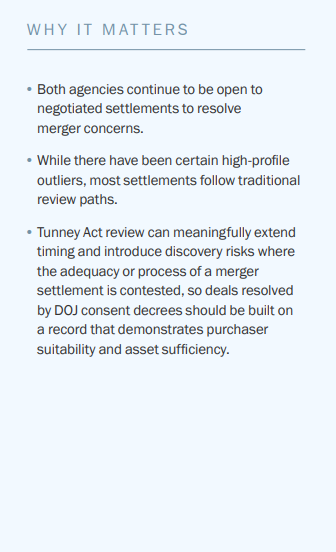
On November 18, 2025, the U.S. District Court for the Northern District of California granted the state AGs’ intervention and subsequently allowed targeted discovery with an evidentiary hearing window identified for late March 2026 if the court deems live testimony necessary.[22]
The DOJ has filed responses to public comments and proposed refinements to its Final Judgment, while the settlement remains under Tunney Act review.[23]
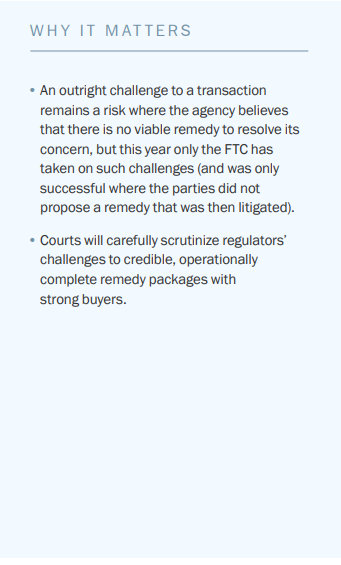
Continued FTC Activity Challenging Deals in Litigation with Mixed Results
On April 17, 2025, the FTC and the Attorneys General of Illinois and Minnesota filed suit seeking to enjoin GTCR’s proposed acquisition of Surmodics. After the parties executed a divestiture agreement with Integer and “litigated the fix,” the U.S. District Court for the Northern District of Illinois denied a preliminary injunction on November 10, 2025, crediting the divestiture buyer’s capabilities and rejecting the FTC’s proposed market definition as overly narrow.[24]
In connection with the FTC’s August 2025 challenge of Edwards Lifesciences’ proposed acquisition of JenaValve Technology, by contrast, the federal district court for the District of Columbia granted the FTC’s motion for preliminary injunction on January 9, 2026, accepting the FTC’s theory that the transaction would have combined the two leading companies competing to bring a particular heart device to market.[25] Edwards then terminated the transaction.[26]
The FTC also filed a complaint on December 11, 2025 to block Henkel’s proposed $725 million acquisition of the Liquid Nails construction adhesives brand, alleging a retail channel duopoly with Loctite that would harm consumers through higher prices and reduced innovation.[27] That case remains pending.
CFIUS – KEY DEVELOPMENTS
The Trump Administration’s National Security Strategy
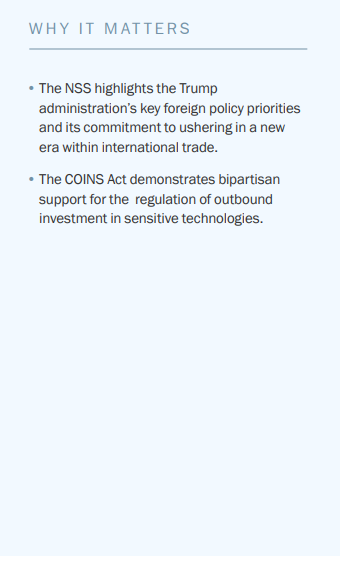
In November 2025, the Trump administration issued its National Security Strategy (the “NSS”), setting the tone and priorities for foreign policy over the next three years.[28] Stated priorities in the NSS include border security, economic security and the protection of core rights and liberties, among others. The NSS notes that economic security is fundamental to national security, and emphasizes balanced trade relations, securing access to critical supply chains and materials, reindustrialization, energy dominance, reviving the defense industrial base and preserving and growing the country’s financial sector dominance as critical to American foreign policy. The NSS also highlights the U.S.-China relationship, and states, “Going forward, we will rebalance America’s economic relationship with China, prioritizing reciprocity and fairness to restore American independence.”[29]
The Comprehensive Outbound Investment Security Program
On December 18, 2025, President Trump signed into law the National Defense Authorization Act for Fiscal Year 2026, which includes the Comprehensive Outbound Investment National Security Act of 2025 (the “COINS Act”). The COINS Act expands the already existing Outbound Investment Security Program, and codifies restrictions on outbound investment in certain technologies, including high-performance computing and supercomputing and hypersonic systems. The COINS Act also broadens the definition of “country of concern” from just the People’s Republic of China to also include Cuba, Iran, North Korea, Russia and Venezuela under the regime of Nicolas Maduro. The COINS Act additionally provides for the creation of a publicly accessible, non-exhaustive database of covered foreign persons engaged in prohibited or notifiable technologies and directs the Secretary of Treasury to create a process for the public to obtain feedback on a confidential basis as to whether a transaction would constitute a covered national security transaction in a prohibited technology. [30]
INVESTIGATIONS – DOJ’S DATA SECURITY PROGRAM
DOJ’s New Regulations Governing Bulk Data Transfers Comes into Full Force
In October 2025, the DOJ’s Data Security Program (“DSP”) took full effect.[31] The DSP, described by the DOJ as “effectively export controls” for data, prohibits and/or restricts U.S. persons from engaging in covered data transactions involving U.S. government-related data and specified bulk amounts of U.S. citizens’ sensitive personal data with covered persons and countries of concern, which include China, Cuba, Iran, North Korea, Russia and Venezuela.[32]
There are specified, limited exemptions, including for certain financial services and corporate group data transactions, but there are no exemptions for anonymized, pseudonymized, de-identified or encrypted data.
Sensitive personal data includes: human ‘omic (genomic, epigenomic, proteomic and transcriptomic), biometric, geolocation, health and financial data, as well as other covered personal identifiers (such as government identification or account numbers, full financial account or personal identification numbers and demographic or contact data).

CYBERSECURITY – CPPA REGULATIONS APPROVED
New California Regulations Requiring Risk Assessments, Cybersecurity Audits, ADMT-Related Notices and Opt-Out Mechanisms
In September 2025, the California Office of Administrative Law approved final regulations proposed by the California Privacy Protection Agency (“CPPA”) related to privacy risk assessments, cybersecurity audits and automated decision-making technology (“ADMT”).[33]
The new regulations require:
- Businesses whose processing of consumers’ personal information “presents significant risk to consumers’ privacy” to conduct a risk assessment before initiating that processing. The risk assessment requirement became effective starting January 1, 2026, with the assessments completed in 2026 and 2027 to be submitted to the CPPA by April 1, 2028.
- Businesses whose processing of consumers’ personal information “presents significant risk to consumers’ security” to complete an annual cybersecurity audit. The audit requirement’s effectiveness is phased based on revenue, with businesses exceeding $100 million in 2026 revenue required to complete their first annual audit by April 1, 2028. Lower-revenue businesses must complete their first audits in later years.
- Businesses that use ADMT “for a significant decision concerning a consumer” must implement certain measures by April 1, 2027, including conducting a risk assessment, providing notice to consumers prior to use of ADMT and providing California consumers the opportunity to opt out of ADMT.

Corporate Governance
PROXY ADVISORS UNDER SCRUTINY: ISS AND GLASS LEWIS BENCHMARK POLICY UPDATES FOR THE 2026 PROXY SEASON
Proxy Advisor Landscape: What’s Changing?
Proxy advisors have come under increased political scrutiny, and stakeholders should expect significant changes beyond the 2026 proxy season, including business model changes by proxy advisors themselves as they anticipate and respond to rulemaking.
In October, Glass Lewis announced, beginning in 2027, it will discontinue its single benchmark voting guidelines and shift to providing a differentiated set of client-specific frameworks, citing diverging investor priorities and investment approaches.[34] Glass Lewis also acknowledged political scrutiny of proxy advisors as a factor in their decision.
By contrast, Institutional Shareholder Services (ISS) has indicated it will maintain its benchmark policy framework and continue regular annual updates while expanding its offerings to include research that does not contain voting recommendations.[35] Notably, in February 2025, ISS stated it will no longer factor gender or racial/ethnic diversity into its director election voting recommendations.[36]
On December 11, 2025, President Trump signed an executive order titled “Protecting American Investors from Foreign-Owned and Politically-Motivated Proxy Advisors” (the “Order”).[37] The Order directed the Securities and Exchange Commission (the “SEC”), Federal Trade Commission and Department of Labor to increase oversight of proxy advisors through potential registration as Registered Investment Advisers, antifraud enforcement, transparency, antitrust review and updates to ERISA regulations and guidance (including, among other things, whether ERISA fiduciary standards should be applied to proxy advisors). The Order set no deadlines, and the Order is not expected to have a major impact on the 2026 proxy season, but could significantly impact the 2027 proxy season depending on regulatory actions in response to the Order.
Amidst this scrutiny, ISS and Glass Lewis updated their 2026 U.S. benchmark proxy voting policy guidelines as follows, with ISS’s guidelines effective for meetings on or after February 1, 2026, and Glass Lewis’s guidelines effective for meetings on or after January 1, 2026.[38],[39]
Key ISS updates:
- Capital structure and voting rights – Clarifies opposition to multi-class capital structure with unequal voting rights except in narrow circumstances (as-converted preferred; limited, mirrored voting) and generally opposes creating new superior-voting power classes.
- Shareholder proposals – Updates voting generally “for” climate/GHG, diversity/equal opportunity, human rights and political spending proposals to case-by-case voting guidance.
- Pay-for-performance – Extends quantitative peer alignment from three to five years and revises the evaluation of CEO pay multiple to peer median from a one-year period to one- and three-year periods.
- Equity Plan Scorecard – Adds a scored factor for disclosing cash-denominated award limits for non-employee directors and adds an against voting override if the plan has insufficient positive features.
Key Glass Lewis updates:
- Mandatory arbitration – Treated as a “highly restrictive” provision and may recommend against governance committee members when such provisions appear at IPO/spin/direct listing, and generally oppose amendments adding such provisions absent a compelling rationale.
- Pay-for-performance – Replaces A-F grading scale with a scorecard approach that uses up to six quantitative tests that are aggregated to determine an overall score ranging from 0 to 100; extends quantitative look-back from three to five years.
- Shareholder proposals and rights – May recommend against the governance chair/committee if the board limits the ability of shareholders to submit proposals (noting possible mid-season updates), restricts derivative suits or replaces majority with plurality voting.
- Governance documents – Opposes bundling of charter/bylaw amendments.
SEC’S DIVISION OF CORPORATION FINANCE NARROWS REVIEW OF RULE 14A-8 NO-ACTION LETTER REQUESTS
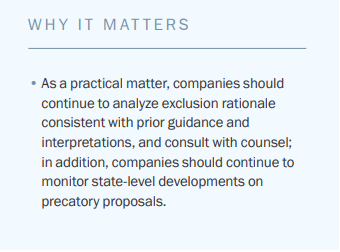
On November 17, 2025, the SEC’s Division of Corporation Finance announced a major procedural shift in the treatment of Rule 14a-8 shareholder proposal exclusions that will impact the 2026 proxy season.[40] Except for requests under Rule 14a-8(i)(1), which address whether a proposal is a proper subject for shareholder action under state law, the staff will not provide substantive responses to company no-action requests or otherwise express a view on the excludability of shareholder proposals. Companies must still comply with Rule 14a-8(j) by notifying the SEC and the proponent of any intended exclusion at least 80 calendar days before filing their definitive proxy statement. However, that notice is now deemed informational only, and staff concurrence is not required to omit a proposal.
The staff will continue to review and respond to Rule 14a-8(i)(1) requests, which typically include a state law opinion of counsel. The carve-out of Rule 14a-8(i)(1) requests reflects ongoing discussions highlighted in recent public remarks about whether nonbinding, “precatory” proposals are proper matters for shareholder action under Delaware or other state laws. The SEC staff indicated it will maintain traditional Rule 14a-8(i)(1) review until there is sufficient guidance for market participants to evaluate these issues independently.
For all other bases of exclusion, companies may still request a staff response by including in their Rule 14a-8(j) notice an unqualified representation that the company has a reasonable basis to exclude the proposal based on Rule 14a-8, prior published guidance and/or judicial decisions; prior unfavorable staff responses, or absence of favorable ones, should not preclude a company from forming a reasonable basis for exclusion.
In such cases, the staff will issue a written response, based solely on the company’s representation and without evaluating the merits of the company’s position, that it will not recommend enforcement action if the company omits the proposal.
This policy is effective for the current proxy season and applies retroactively to pending requests submitted before October 1, 2025 that have not yet received a staff response.
The staff cited resource and timing considerations following the lengthy federal government shutdown, a backlog of time-sensitive filings (including registration statements) and the extensive body of existing Rule 14a-8 guidance as some of the key drivers of the shift. While the procedural shift may appear to simplify exclusion decisions, it also introduces some degree of uncertainty. Without substantive staff concurrence, companies that omit proposals may find themselves engaged in litigation with proponents or subject to scrutiny from certain institutional investors or proxy advisory firms. Some companies may also conclude that, absent clear procedural defects or straightforward substantive grounds for exclusion, and where a proposal appears unlikely to receive substantial support, submitting proposals to a vote is the more prudent course of action this proxy season.
For more discussion of the SEC’s action, please see our November 21, 2025 memo. [41]
SEC DEVELOPMENTS
SEC Addresses Reforms to Wells Process
In October 2025, Chairman Paul Atkins announced reforms to the SEC’s so-called Wells process by which prospective defendants in SEC enforcement matters are able to present their counterarguments to the SEC before a case is brought.[42] Key changes include requiring the Enforcement staff to provide additional non-confidential investigative materials, such as testimony transcripts and key documents, so respondents can understand proposed charges; allowing at least four weeks for respondents to make Wells submissions, with possible extensions in complex cases; and providing every Wells submission in both settled and contested matters to the Commissioners.
SEC Advisory Committee Recommends AI Disclosure Rules
On December 4, 2025, the SEC’s Investor Advisory Committee (the “Committee”) recommended that the SEC integrate AI-specific disclosure guidance into existing Reg S–K items.[43] The Committee recommended guidance that would require issuers to: adopt a definition of “artificial intelligence”; disclose board-level oversight of AI deployment; and, where material, separately report how AI is used and its effects on internal operations and consumer-facing matters.
The Committee’s recommendation is non-binding and faced criticism from SEC Commissioners. Chairman Atkins urged the Commission to “resist the temptation to adopt prescriptive disclosure requirements for every ‘new thing’ that affects a business,” and Commissioner Peirce questioned whether AI disclosures should “force conformity.”
SEC Dismisses Cyber Disclosure Case Against SolarWinds and CISO
The SEC announced on November 20, 2025 a joint stipulation to dismiss with prejudice its civil enforcement case against SolarWinds and its Chief Information Security Officer arising from SolarWinds’ 2020 cyber incident disclosures.[44] The dismissal followed a July 2024 ruling that dismissed most claims and concludes the litigation without further proceedings or penalties.
For more discussion of SolarWinds, please see our 2024 Q3 Quarterly Report. [45]

OTHER DEVELOPMENTS
Spending Bill Extends Section 16 Reporting Obligations to FPIs
On December 18, 2025, President Trump signed into law the National Defense Authorization Act for Fiscal Year 2026 (the “Act”), which includes Section 8103, the Holding Foreign Insiders Accountable Act (“HFIAA”).[46] The HFIAA amends Section 16(a)(1) of the Securities Exchange Act of 1934 to require directors and officers of foreign private issuers (“FPIs”) to report their beneficial ownership and transactions in equity securities on Forms 3, 4 and 5. Prior to the Act, FPI officers and directors were exempt from Section 16(a) reporting.
Importantly, the HFIAA does not modify Sections 16(b) or 16(c) for FPIs. Accordingly, FPI directors and officers remain exempt from the short-swing profit recovery provisions of Section 16(b) and the short-sale prohibitions of Section 16(c). In addition, although Section 16(a) applies to domestic beneficial owners of more than 10%, the HFIAA does not extend Section 16(a) reporting to beneficial owners of more than 10% of an FPI.
California Climate Disclosure Law (“SB 261”) Halted by Ninth Circuit
On November 18, 2025, the Ninth Circuit granted an injunction that halted enforcement of California’s climate-related financial risk disclosure law, SB 261, weeks before the January 1, 2026 first report deadline.[47] The order did not impact the Climate Corporate Data Accountability Act (“SB 253”), which remains in effect. The Ninth Circuit heard oral arguments on the appeal on January 9, 2026.
For more discussion of SB 261, please see our October 9, 2023 memo. [48]
Eleventh Circuit Finds Corporate Transparency Act Is Constitutional
On December 16, 2025, the Eleventh Circuit held that the Corporate Transparency Act (the “CTA”) was a constitutional exercise of Congressional power.[49] Despite the ruling, reporting obligations for many domestic companies will not change because, in March, the Treasury Department’s Financial Crimes Enforcement Network issued an interim final rule which eliminated the reporting requirements for U.S. persons and for domestic reporting companies, limiting primary reporting obligations to certain foreign reporting companies.
For more discussion of the CTA, please see our 2024 Q4 Quarterly Report.[50]

The authors wish to acknowledge the contributions of associates Rohan Sagar Naik and Jesse A. Shulman to this memorandum.
111 U.S.C. § 363.(go back)
2U.C.C. §§ 9-607, 9-609, 9-610, 9-620, 9-622 (Am. Law Inst. & Unif. Law Comm’n 2022).(go back)
310 Del. C. 1953, §§ 7381-7387 (2025); N.Y. Debt. & Cred. L. §§ 2-24 (2025); §§ 727.101-727.117, Fla. Stat. (2025). California does not have an ABC statute; ABCs are governed by a purely common law regime.(go back)
4Press Release, Pet Food Experts, Pet Food Experts Acquires Animal Supply Company Assets, Becoming the Nation’s #1 Pet Specialty Distributor (Feb. 26, 2025), https://blog.petfoodexperts.com/pet-food-experts-acquires-animal-supply-company-assets-becoming-the-nations-1-pet-specialty-distributor(go back)
5Press Release, Do It Best, Do It Best Successfully Completes Purchase of True Value (Nov. 22, 2024), https://www.doitbestonline.com/2024/do-it-best-successfully-completes-purchase-of-true-value/; Decl. of John Hartigan in Support of Entry of the Sale Order, In re True Value Company, L.L.C., et al., No. 24-12337 (Bankr. D. Del. Nov. 5, 2024), Dkt. No. 364.(go back)
6Stmt. of Financial Affairs for True Value Company, L.L.C., In re True Value Company, L.L.C., et al., No. 24-12337 (Bankr. D. Del. Nov. 5, 2024), Dkt. No. 213.(go back)
7Patrick Fitzgerald & Harvard Zhang, UPDATE 5: New Foundever Co-Op Secures 88% Uptake, Octus Intel (Jan. 7, 2026, at 3:00 PM ET), https://app.octus.com/v3#/items/intel/14396?item_id=359464.(go back)
8Robert Schach & Harvard Zhang, UPDATE 4: Altice France Secured Creditor Co-Op Extension Support Reaches 94% After Final Count, Octus Intel (Oct. 2, 2024, at 6:34 AM ET), https://octus.com/resources/articles/altice-france-secured-creditor-co-op-extension-support-reaches-94/.(go back)
9Press Release, DuPont de Nemours Inc., DuPont Announces Commencement of Exchange Offers and Consent Solicitations for Senior Notes (Sep. 2, 2025), https://www.investors.dupont.com/news-and-media/press-release-details/2025/DuPont-Announces-Commencement-of-Exchange-Offers-and-Consent-Solicitations-for-Senior-Notes/default.aspx.(go back)
10Harvard Zhang, UPDATE 3: DuPont 2048 Notes Co-Op Goes Effective, Adding Additional Block of Company’s Exchange Offers, Octus Intel (Sep. 11, 2025, at 5:50 PM ET), https://app.octus.com/v3#/items/intel/15210?item_id=340156.(go back)
11In re Serta Simmons Bedding, LLC, 125 F.4th 555 (5th Cir. 2024), as amended, No. 23-20281 (5th Cir. Jan. 21, 2025), revised and superseded, No. 23-20181 (5th Cir. Feb. 14, 2025), reh’g denied, No. 23-20181 (5th Cir. Feb. 18, 2025).(go back)
12Memorandum Order Regarding the 2024/2026 Noteholders’ Breach-of-Contract Claims, Wesco Aircraft Holdings, Inc., et al., vs. SSD Investments LTD, et al., No. 4:25-CV-202 (S.D. Tex. Dec. 8, 2025), Dkt. No. 119.(go back)
13Complaint for Violations of the Sherman Act and New York State Law, Optimum Communications Inc., et al., v. Apollo Capital Management L.P., et al., No. 25-cv-9785 (S.D.N.Y. Nov. 25, 2025), Dkt. No. 1.(go back)
14Complaint, Deltroit Directional Opportunities Master Fund Limited v. Selecta Group B.V., No. 1:25-cv-08956-JPO (S.D.N.Y. Oct. 29, 2025), Dkt. No. 1.(go back)
1590 FR 53144.(go back)
1689 FR 25980.(go back)
17Press Release, Justice Department Requires Divestitures to Proceed with Constellation’s Proposed $26.6 Billion Acquisition of Calpine, Department of Justice (Dec. 5, 2025), https://www.justice.gov/opa/pr/justice-department-requires-divestitures-proceed-constellations-proposed-266-billion.(go back)
18Constellation Completes Calpine Transaction, Powering America’s Clean Energy Future, Constellation Communications (Jan. 7, 2026), https://www.constellationenergy.com/newsroom/2026/01/constellation-completes-calpine-transaction-powering-americas-clean-energy-future.html.(go back)
19Press Release, FTC Requires Boeing to Divest Several Spirit Assets to Proceed with Merger, Federal Trade Commission (Dec. 3, 2025), https://www.ftc.gov/news-events/news/press-releases/2025/12/ftc-requires-boeing-divest-several-spirit-assets-proceed-merger.(go back)
20Press Release, Boeing Completes Acquisition of Spirit AeroSystems, Boeing (Dec. 8, 2025), https://investors.boeing.com/investors/news/press-release-details/2025/Boeing-Completes-Acquisition-of-Spirit-AeroSystems/default.aspx.(go back)
21Press Release, Justice Department Requires Divestitures and Licensing Commitments in HPE’s Acquisition of Juniper Networks, Federal Trade Commission (June 28, 2025), https://www.justice.gov/opa/pr/justice-department-requires-divestitures-and-licensing-commitments-hpes-acquisition-juniper.(go back)
22Josh Sisco, HPE-Juniper Deal Still Under Fire by States After DOJ Approval, Bloomberg (Dec. 31, 2025), https://www.bloomberg.com/news/articles/2025-12-31/hpe-juniper-deal-still-under-fire-by-states-after-doj-approval.(go back)
23Press Release, United States v. Hewlett Packard Enterprise Co. and Juniper Networks, Inc.; Response of the United States to Public Comments on the Proposed Final Judgments, Department of Justice (Nov. 19, 2025), https://www.federalregister.gov/documents/2025/11/19/2025-20260/united-states-v-hewlett-packard-enterprise-co-and-juniper-networks-inc-response-of-the-united-states.(go back)
24Jody Godoy, US judge rejects FTC’s bid to block private equity medical company deal, Reuters (Nov. 10, 2025), https://www.reuters.com/world/us-judge-rejects-ftcs-bid-block-private-equity-medical-company-deal-2025-11-10/.(go back)
25Press Release, Statement on FTC Victory Halting Anticompetitive Medical Device Deal, Federal Trade Commission (Jan. 12, 2026), https://www.ftc.gov/news-events/news/press-releases/2026/01/statement-ftc-victory-halting-anticompetitive-medical-device-deal.(go back)
26Press Release, Edwards Comments on JenaValve Acquisition, Edwards (Jan. 9, 2026), https://www.edwards.com/newsroom/news/2026-01-09-edwards-comments-on-jenavalve-acquisition.(go back)
27Press Release, FTC Sues to Stop Loctite, Liquid Nails Construction Adhesive Merger, Federal Trade Commission (Dec. 11, 2025), https://www.ftc.gov/news-events/news/press-releases/2025/12/ftc-sues-stop-loctite-liquid-nails-construction-adhesive-merger.(go back)
28National Security Strategy of the United States of America, The White House (Nov. 2025), https://www.whitehouse.gov/wp-content/uploads/2025/12/2025-National-Security-Strategy.pdf.(go back)
29Id.(go back)
30S.1071 – 119th Congress (2025-2026): National Defense Authorization Act for Fiscal Year 2026, S.1071, 119th Cong. (2025), https://www.congress.gov/bill/119th-congress/senate-bill/1071.(go back)
3128 C.F.R. 202.(go back)
32Press Release, Justice Department Implements Critical National Security Program to Protect Americans’ Sensitive Data from Foreign Adversaries, U.S. Department of Justice (April 11, 2025), https://www.justice.gov/opa/pr/justice-department-implements-critical-national-security-program-protect-americans-sensitive.(go back)
33Announcement, California Finalizes Regulations to Strengthen Consumers’ Privacy, California Privacy Protection Agency (Sept. 23, 2025), https://cppa.ca.gov/announcements/2025/20250923.html.(go back)
34Glass Lewis 2026 Policy Guidelines announcement (October 2025).(go back)
35ISS 2026 Benchmark Policy Framework announcement.(go back)
36ISS statement on diversity factors in director election recommendations (February 2025).(go back)
37Executive Order, Protecting American Investors from Foreign-Owned and Politically-Motivated Proxy Advisors, The White House (Dec. 11, 2025).(go back)
38ISS 2026 U.S. Benchmark Proxy Voting Guidelines (effective February 1, 2026).(go back)
39Glass Lewis 2026 U.S. Benchmark Proxy Voting Guidelines (effective January 1, 2026).(go back)
40SEC Division of Corporation Finance, Staff Legal Bulletin on Rule 14a-8 No-Action Letter Requests (Nov. 17, 2025).(go back)
41Cravath Memorandum on SEC’s Rule 14a-8 No-Action Letter Policy (Nov. 21, 2025).(go back)
42SEC Chairman Paul Atkins, Announcement of Wells Process Reforms (October 2025).(go back)
43SEC Investor Advisory Committee Recommendation on AI Disclosure (Dec. 4, 2025).(go back)
44SEC Press Release, Joint Stipulation to Dismiss SolarWinds Civil Enforcement Case (Nov. 20, 2025).(go back)
45Cravath 2024 Q3 Quarterly Report.(go back)
46National Defense Authorization Act for Fiscal Year 2026, Section 8103, Holding Foreign Insiders Accountable Act (Dec. 18, 2025).(go back)
47Ninth Circuit Order Granting Injunction Halting SB 261 Enforcement (Nov. 18, 2025).(go back)
48Cravath Memorandum on SB 261 (Oct. 9, 2023).(go back)
49Eleventh Circuit Opinion, Corporate Transparency Act Constitutional (Dec. 16, 2025).(go back)
50Cravath 2024 Q4 Quarterly Report.(go back)
Legal Disclaimer:
EIN Presswire provides this news content "as is" without warranty of any kind. We do not accept any responsibility or liability for the accuracy, content, images, videos, licenses, completeness, legality, or reliability of the information contained in this article. If you have any complaints or copyright issues related to this article, kindly contact the author above.
